






































































































































































Beyond the Scale: Transforming Your Mindset for Fat Loss
Author: RVLNSV PRASAD
Updated On: October 2026
About Us
Author Bio
Editorial Policy
Contact Us
Quick Answer
A mindset for fat loss is not simply “thinking positively.” It is the way you approach eating, physical activity, setbacks, motivation, body weight, and long-term behavior change.
A useful mindset shifts attention away from rapid results and toward repeatable behaviors. Instead of asking, “How much weight did I lose this week?” ask:
“What healthy behaviors can I repeat this week?”
Evidence from behavioral and cognitive-behavioral interventions suggests that techniques such as goal setting, self-monitoring, feedback, cognitive restructuring, and practical support can contribute to weight-management outcomes. A 2024 systematic review and network meta-analysis found that behavioral therapy and cognitive behavioral therapy were effective approaches for weight loss, with monitoring and feedback among commonly used behavioral techniques.
That does not mean mindset can overcome every biological, medical, environmental, or socioeconomic factor affecting body weight.
The World Health Organization describes obesity as a chronic, relapsing disease involving complex interactions among genetics, neurobiology, eating behaviors, access to food, and the broader environment.
It means your thinking can influence the behaviors you practice repeatedly—and those behaviors matter.
Introduction: Fat Loss Starts With More Than a Number
For many people, the bathroom scale becomes the scoreboard. A lower number can feel encouraging, while an unexpected increase may create frustration and self-doubt.
This can create a difficult cycle. You may follow a diet carefully for several days, become discouraged when your weight stops moving, and eventually begin questioning the entire plan. One difficult meal can then turn into an entire day or weekend of abandoning your routine.
The problem may not be a lack of willpower. An all-or-nothing approach to behavior change can make ordinary setbacks feel much bigger than they actually are.
Modern weight-management guidance treats healthy weight management as a combination of healthy eating, regular physical activity, adequate sleep, and stress management rather than a single diet or short-term intervention.
The World Health Organization emphasizes that higher weight and obesity are influenced by multiple biological, environmental, behavioral, and psychosocial factors.
So what should you change?
Not only your food choices or exercise routine. The way you respond to the process matters too, and that is where a practical mindset for fat loss becomes useful.
What Does Mindset for Fat Loss Really Mean?
Mindset for fat loss means developing a realistic way of thinking about weight management. It includes how you respond when the scale does not move, you eat more than planned, you miss a workout, stress increases your appetite, progress slows, other people appear to lose weight faster, motivation disappears, or some weight returns.
A strong mindset does not mean pretending that everything is easy. Instead, it means learning how to respond without allowing one setback to become a reason to abandon your goals.
The NIDDK explains that changing health behaviors happens through stages, including preparation, action, and maintenance, and that roadblocks and setbacks can occur during the process.
This approach is much more realistic than expecting yourself to remain motivated every day.
Mindset Is Not a Substitute for Nutrition
This point matters because positive thinking alone cannot create a calorie deficit.
Fat loss still depends on energy balance, food intake, physical activity, individual biology, and other factors. Your mindset is better understood as a behavior-support system that can help you make and repeat decisions supporting your physical goals.
The CDC also notes that medications, medical conditions, stress, genes, hormones, environment, and age can affect weight management.
My Personal Experience: Why I Stopped Chasing the Scale
There was a time when I focused heavily on results and checked my weight frequently. When the number moved down, I felt encouraged, but when it stayed the same, frustration quickly appeared.
My motivation had become too dependent on a measurement that could change for many reasons.
Later, I began paying more attention to my behaviors. I asked myself whether I was eating regular meals, moving consistently, sleeping well, and recognizing when stress was influencing my eating.
I also started noticing whether one difficult meal was causing me to abandon the entire day.
That changed the way I looked at progress.
The scale was still useful, but it was no longer the only measurement. This distinction became important because sustainable weight management is not simply about reaching a target number; it also involves developing behaviors that can be maintained over time.
The NIDDK recommends tracking progress, reviewing goals, planning for roadblocks, and returning to healthy behaviors after setbacks.
7 Mindset Shifts That Can Support Fat Loss
1. Focus on Behaviors Before Outcomes
One of the biggest mistakes is making the scale your only goal.
“Lose 10 kilograms” is an outcome, whereas “walk after dinner five days a week” is a behavior. You cannot completely control the first, but you can directly influence the second.
This is why specific behavioral goals can be more useful than vague intentions.
Instead of saying:
“I need to lose weight.”
Try:
“I will prepare my lunch at home four days this week.”
Another practical example would be
“I will walk for 20 minutes after dinner on Monday, Wednesday, Friday, and Saturday.”
The NIDDK recommends setting specific, achievable goals rather than relying on broad intentions such as simply deciding to “be more active.”
A Simple Behavior-First Table
| Outcome goal | Behavior goal |
|---|---|
| Lose body fat. | Follow a sustainable eating pattern. |
| Get fitter. | Walk or exercise regularly. |
| Eat less mindlessly. | Eat meals without screens. |
| Reduce overeating. | Identify common eating triggers. |
| Maintain weight | Continue monitoring useful habits. |
| Improve consistency. | Plan for predictable obstacles |
The goal is not to ignore the scale. Instead, it is to stop allowing the scale to control your entire emotional response.
2. Replace “Perfect or Failed” With “Back on Track.”
All-or-nothing thinking can make a small mistake feel enormous. You might eat a large restaurant meal and immediately think, “I ruined my diet,” which can then lead to continued overeating for the rest of the day.
Sometimes that reaction can continue into the entire weekend.
A more useful response is
“That meal happened. My next decision is still available.”
This does not mean ignoring nutrition. It simply prevents one event from becoming a prolonged period of abandoning your plan.
Digestive and Kidney Diseases (NIDDK): Setbacks such as overeating are a normal part of weight management, and the recommended approach is to regroup and return to your healthy eating plan rather than viewing one episode as a failure.
Try the Next-Meal Rule.
After an overeating episode:
- Do not starve yourself to compensate.
- Do not punish yourself with excessive exercise.
- Drink water according to your normal needs.
- Return to your normal eating pattern.
- Identify what triggered the episode.
- Change one environmental factor if possible.
This approach is more practical than trying to “make up” for food through extreme restriction.
3. Learn to Separate Hunger From Emotional Eating
Hunger is not the only reason people eat. Stress, boredom, loneliness, tiredness, habit, social situations, and easy access to food can all influence eating behavior.
This does not mean every emotional eating episode is a psychological disorder. It simply means that understanding your triggers can help you choose a different response.
The National Institute of Diabetes and Digestive and Kidney Diseases (NIDDK) recommends keeping track of eating habits, physical activity, emotions, and challenges because recognizing patterns can help you identify barriers and make practical changes.
Try the Five-Question Pause.
Before an unplanned snack, ask yourself:
1. Am I physically hungry?
2. What am I feeling right now?
3. What happened immediately before this craving?
4. Would I eat a normal meal right now?
5. What would help me for the next 10 minutes?
Sometimes the answer will still be food, and that is okay.
The purpose is not to eliminate every craving. Instead, it is to create a small gap between the trigger and the response so that you have an opportunity to make a conscious decision.
4. Practice Self-Compassion Instead of Self-Attack
Self-compassion is often misunderstood as letting yourself off the hook, but that is not its purpose. It means responding to mistakes without unnecessary self-criticism while still taking responsibility for your actions.
A systematic review of 20 studies found that self-compassion interventions generally increased self-compassion, while some studies also reported improvements in eating behaviors, physical activity, or weight. However, the researchers emphasized methodological limitations and said stronger evidence is needed before making firm conclusions about weight outcomes.
That is a much more responsible conclusion than saying:
“Self-love causes weight loss.”
It does not.
However, treating yourself with less hostility may make it easier to respond constructively when things go wrong.
Replace These Thoughts
Instead of:
“I have no discipline.”
Try:
“Something made this difficult today. What can I change tomorrow?”
Instead of:
“I ruined everything.”
Try:
“One meal does not decide my entire journey.”
Instead of:
“I always fail.”
Try:
“This approach has not worked consistently yet. I can adjust it.”
This is not empty positive thinking. It is a form of practical problem-solving.
5. Stop Comparing Your Body With Someone Else’s
Comparison is especially difficult in the age of social media. You may see someone who appears to lose weight quickly without knowing their complete health history, medication use, genetics, food intake, activity level, sleep, stress, or starting weight.
Even people following similar diets can experience different outcomes.
The WHO explains that obesity and excess weight involve multiple interacting factors, including genetics, eating behaviors, neurobiology, environment, and access to healthy food.
Therefore, another person’s result is not a reliable timetable for your body.
Create Your Own Scoreboard
Track things such as
| Area | Question |
|---|---|
| Food | Am I following my planned eating pattern more consistently? |
| Activity | Am I moving more regularly? |
| Strength | Am I becoming stronger? |
| Sleep | Is my sleep routine improving? |
| Stress | Am I handling difficult moments better? |
| Eating behavior | Am I noticing triggers earlier? |
| Weight | Is the longer-term trend moving in the desired direction? |
The scale remains useful, but it becomes one piece of information rather than a judgment about your worth.
6. Build Consistency, Not Perfection
A sustainable plan needs to survive ordinary life, including birthdays, travel, family meals, busy workdays, rainy evenings, low-energy mornings, and unexpected events.
A plan that works only under perfect conditions is not a very useful long-term strategy.
NIDDK advises people to plan for roadblocks, review their goals, and get back on track after setbacks rather than giving up.
Use the Minimum-Version Strategy.
On a difficult day, reduce the size of the habit instead of abandoning it.
For example:
Normal day: 30-minute walk.
Busy day: 10-minute walk.
Very difficult day: Five minutes of movement.
The purpose is not to suggest that five minutes equals 30 minutes; rather, the idea is to maintain the routine of taking action, making it easier to return to the full behavior when circumstances improve.
The National Institute of Diabetes and Digestive and Kidney Diseases (NIDDK) notes that even short periods of physical activity can be beneficial, while gradually increasing activity based on your fitness level and abilities can make it easier to stay active consistently.
7. Think Beyond Weight: Build a Health Identity
One useful mindset change is to stop seeing yourself only as someone who is “trying to lose weight.” Instead, think about the type of person you want to become.
For example:
“I am someone who plans meals.”
“I am someone who walks regularly.”
“I am someone who gets back on track after setbacks.”
“I am someone who takes care of my health even when motivation is low.”
This does not magically cause fat loss. It changes the question from “How can I force myself to diet?” to “What would a person who cares for their health do today?”
That small shift can make daily decisions feel less like punishment and more like an expression of your priorities.
The Scale Is Useful—But It Is Not the Whole Story
Some people react to this topic by deciding that they should never weigh themselves. That is not necessary.
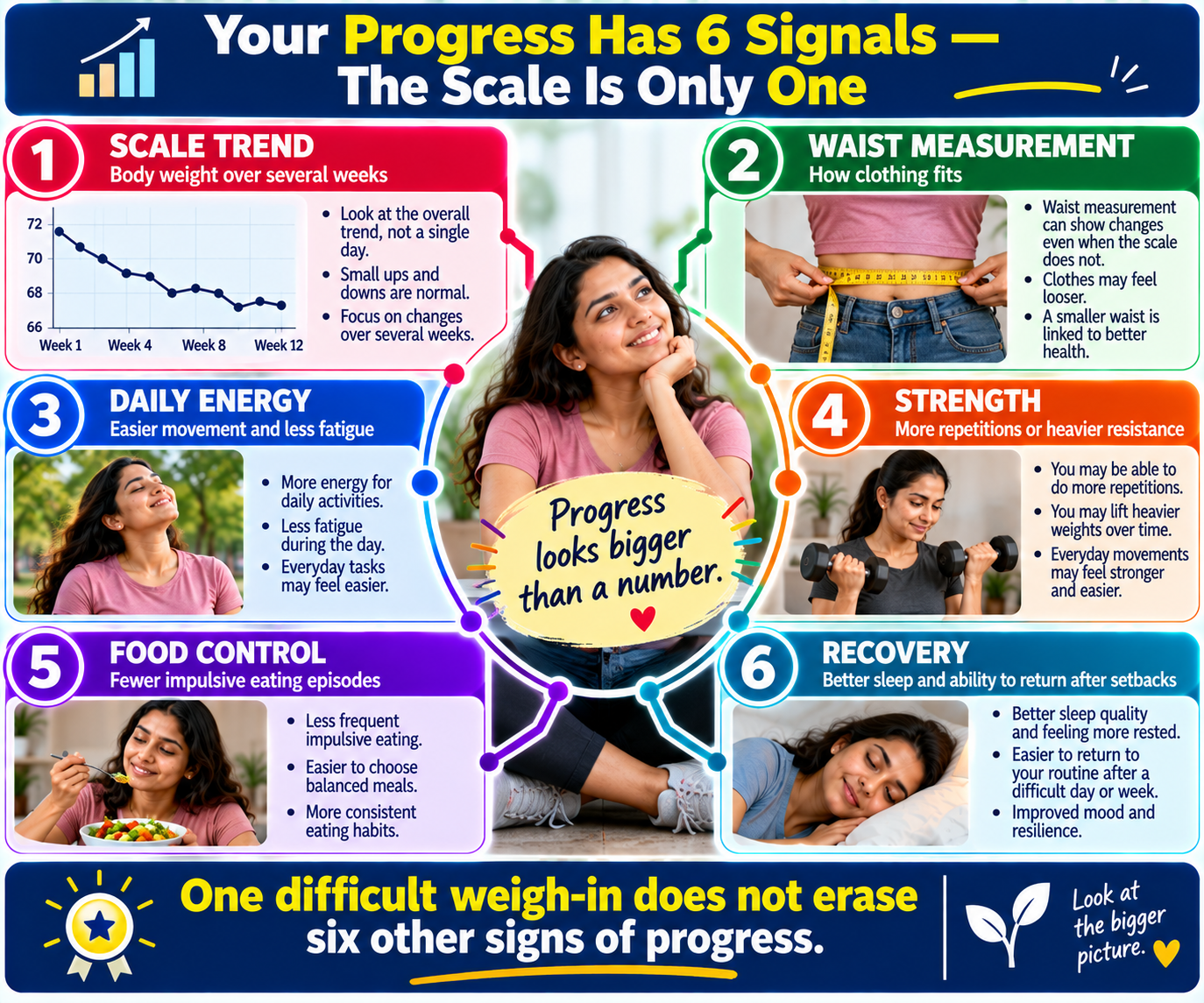
Self-monitoring can be useful for many people. NIDDK includes tracking food, activity, and weight among the practical strategies used in weight-management programs and notes that monitoring can help people stay focused and identify setbacks.
The important issue is how you interpret the information.
A scale measures body weight, but it does not measure your discipline, intelligence, attractiveness, personal value, effort, or overall health.
Daily weight can also fluctuate because of factors such as fluid balance, food volume, sodium intake, bowel contents, hormonal changes, and other normal biological variation.
Therefore, looking at longer-term trends can be more informative than reacting emotionally to one measurement.
For people who find weighing themselves psychologically distressing or triggering, another monitoring approach may be more appropriate.
A Better Way to Set Fat-Loss Goals
Goals should be realistic enough to guide action.
The NIDDK discusses an initial weight-loss goal of approximately 5% to 10% of starting body weight within six months in the context of successful weight-management programs, while emphasizing that goals should be appropriate for the individual.
The CDC notes that even modest weight loss can provide health benefits, including improvements in blood pressure, cholesterol levels, and blood sugar for people who are above a healthy weight.
For example, someone weighing 100 kg might initially discuss a target of 5–10 kg rather than immediately focusing on an extreme long-term number.
That does not mean everyone should aim for exactly that amount. Your age, health conditions, medications, starting weight, physical abilities, nutritional needs, and medical history all matter.
Use Three Levels of Goals
Outcome goal:
A long-term weight or health target.
Behavior goal:
The actions that support that target.
Recovery goal:
What you will do when something goes wrong.
For example:
| Goal type | Example |
|---|---|
| Outcome | Work toward a healthier body weight. |
| Behavior | Walk 30 minutes five days a week. |
| Nutrition | Include vegetables and a protein source in regular meals. |
| Recovery | Return to normal meals after an overeating episode. |
| Monitoring | Review progress weekly rather than emotionally reacting to every fluctuation. |
NIDDK recommends specific goals and ongoing monitoring as components of effective weight-management programs.
Your Environment Can Be Stronger Than Motivation
People often say:
“I need more willpower.”
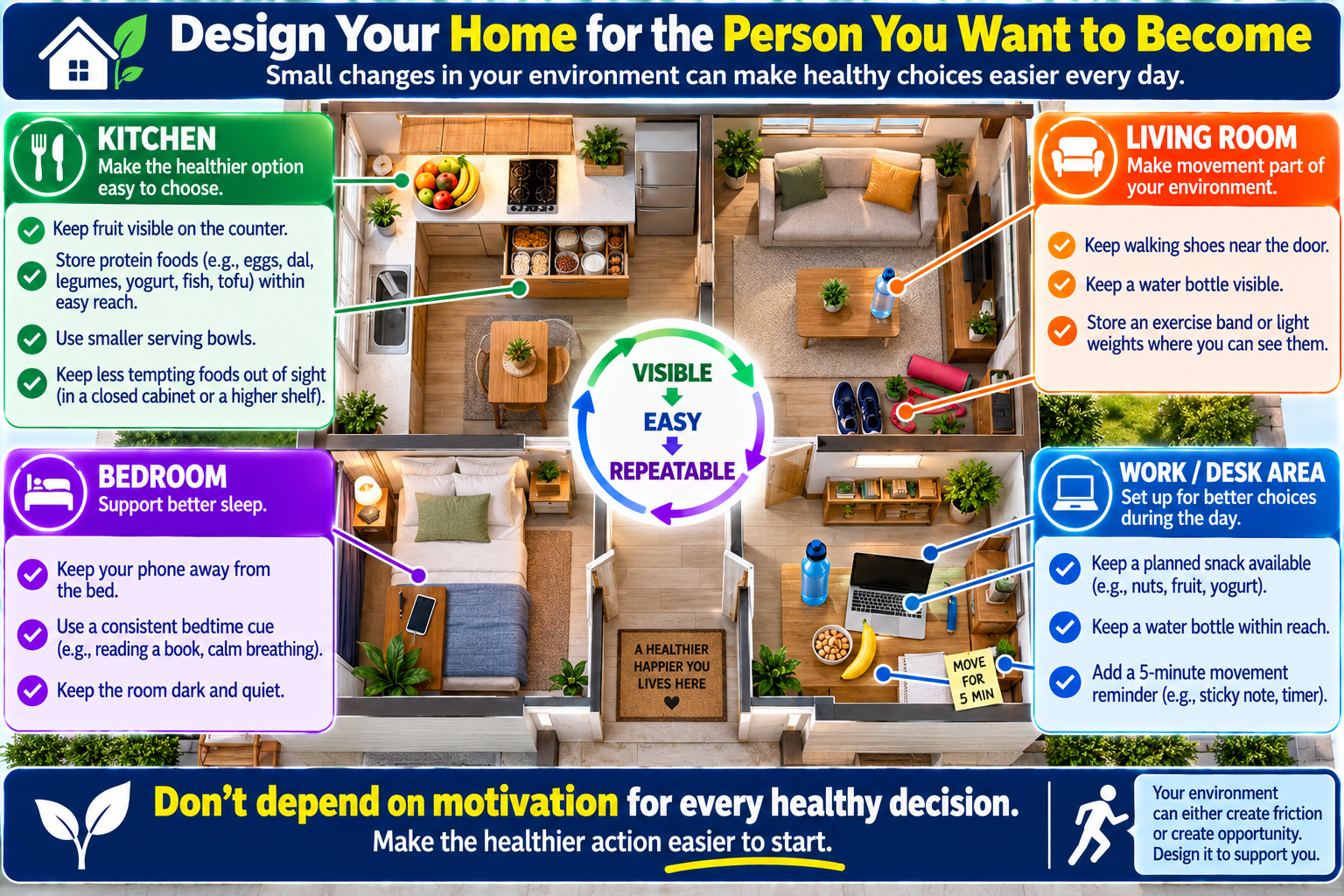
However, environment matters. If high-calorie snack foods are always visible, the decision to ignore them must be repeated, whereas healthier foods that are already prepared can make the preferred choice easier.
The National Institute of Diabetes and Digestive and Kidney Diseases (NIDDK) recommends keeping healthier foods readily available, limiting easy access to foods you want to eat less often, planning meals ahead, and identifying situations that may trigger unplanned eating.
Try a Five-Minute Kitchen Reset
At the end of the day:
- Put fruit where you can see it.
- Prepare tomorrow’s breakfast if practical.
- Keep protein-rich foods readily available.
- Store snack foods rather than leaving them visible.
- Prepare a water bottle if that helps you drink regularly.
- Decide tomorrow’s first meal.
This is not a “fat-burning hack.” It is a decision-making strategy that reduces friction around the behaviors you want to repeat.
Sleep, Stress, and Fat Loss Mindset
A healthy mindset cannot be separated completely from sleep and stress. When you are exhausted or overwhelmed, following a carefully planned routine can become harder.
The CDC identifies healthy eating, regular physical activity, adequate sleep, and stress management as important parts of a lifestyle that supports healthy weight management.
This does not mean that getting more sleep automatically causes fat loss. Instead, sleep should be viewed as one part of the broader health behavior system.
A Simple Evening Reset
Try:
- Finish demanding work earlier when possible.
- Reduce unnecessary screen stimulation before bed.
- Prepare the next day’s food or activity plan.
- Write down one unresolved worry rather than repeatedly thinking about it.
- Keep a reasonably consistent sleep schedule.
The goal is not a perfect bedtime routine. It is to reduce friction and make the next day’s healthier choices easier.
What About “Home Remedies” for Fat Loss?
This is an area where many weight-loss articles become misleading.
Warm water, lemon water, herbal teas, cinnamon drinks, detox beverages, and similar practices are often promoted as fat-burning remedies. There is not strong evidence that these drinks independently cause meaningful body-fat loss.
You can drink warm water if you enjoy it, and unsweetened tea can fit into a healthy eating pattern. However, a comforting habit should not be presented as a proven fat-loss treatment.
A better “home remedy” is actually a home environment strategy:
- keep nutritious foods available
- reduce automatic snacking
- prepare meals before hunger becomes extreme
- walk after meals when appropriate
- eat without distractions
- maintain regular sleep
- create a plan for stressful evenings
These strategies may appear less exciting, but they are consistent with established behavioral weight-management approaches that emphasize planning, tracking, goal setting, environmental changes, and ongoing support.
The 10-Minute Mindset Reset
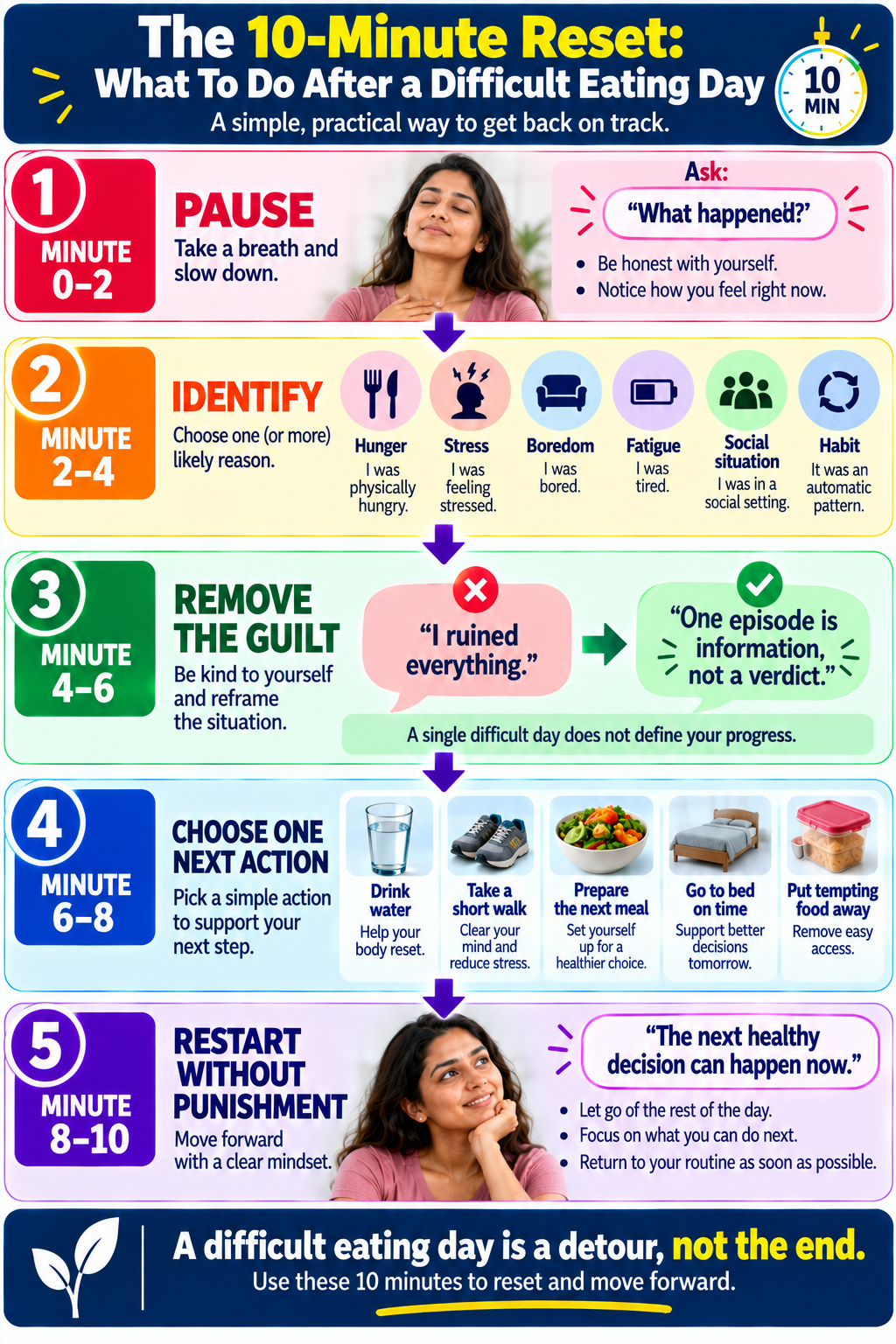
When you feel that your weight-loss effort is failing, try this before immediately changing your diet.
Minute 1–2: Stop
Give yourself a moment before making an emotional decision.
Minute 3–4: Identify
Ask what actually went wrong.
Was it hunger, stress, poor planning, social pressure, lack of sleep, or food availability?
Minute 5–6: Separate
Ask:
“What is within my control?”
Minute 7–8: Choose
Select one small action, such as preparing tomorrow’s breakfast, taking a short walk, removing distracting snacks, going to bed earlier, or planning the next meal.
Minute 9–10: Restart
Do not wait for Monday or the beginning of a new month. Restart at the next reasonable opportunity.
This approach is consistent with NIDDK guidance that setbacks are normal and that people should regroup, identify roadblocks, and return to their goals rather than giving up.
Latest Research: What Is Changing in Weight-Loss Psychology?
Recent research is making the picture more nuanced.
A 2024 systematic review and network meta-analysis found that both behavioral therapy and cognitive behavioral therapy can be effective for weight loss. The review identified feedback and monitoring as commonly used behavioral techniques, while cognitive restructuring was a commonly used cognitive-behavioral technique.
Successful weight management is rarely based on a single psychological trick. Instead, effective approaches often combine goal setting, self-monitoring, feedback, social support, behavior strategies, and practical lifestyle changes. The National Institute of Diabetes and Digestive and Kidney Diseases (NIDDK) similarly emphasizes setting specific goals, tracking progress, addressing barriers, seeking support, and maintaining healthy habits over time.
Research on self-compassion also deserves a careful interpretation. A systematic review found promising improvements in self-compassion and some health behaviors, but the authors cautioned that methodological weaknesses limit strong conclusions about weight outcomes.
This is an important development because the evidence does not support a simple message such as
“Think positively and you will lose weight.”
The more defensible message is:
Behavioral skills, realistic goals, monitoring, cognitive strategies, support, and sustainable lifestyle changes can work together as part of weight management.
That is a stronger and more evidence-based way to understand mindset.
Common Mindset Mistakes That Can Slow Fat Loss
Mistake 1: Expecting Motivation Every Day
Motivation changes, so systems and routines can be more dependable.
Mistake 2: Treating One Meal as Failure
One meal is one event, and your next decision still matters. NIDDK specifically recommends returning to healthy behaviors after setbacks.
Mistake 3: Using Extreme Restriction After Overeating
Punishment can make the cycle harder, so returning to your normal plan is usually more constructive.
Mistake 4: Weighing Yourself Without Understanding Fluctuations
A single number cannot explain everything happening inside your body. Look at trends and context instead.
Mistake 5: Copying Another Person’s Diet
Your nutritional needs and health circumstances may differ from someone else’s.
Mistake 6: Believing Mindset Replaces Medical Care
It does not.
Some people struggle with weight because of medications, medical conditions, sleep problems, genetics, hormonal factors, or other contributors. The CDC specifically notes that medicines, medical conditions, stress, genes, hormones, environment, and age can affect weight management.
Mistake 7: Waiting for Perfect Conditions
Life will rarely become completely convenient, so build a plan that can survive imperfect days. NIDDK recommends planning ahead for roadblocks and having alternative options when circumstances interfere with the original plan.
A Simple 7-Day Mindset Practice
| Day | Practice |
|---|---|
| Monday | Write one specific behavior goal. |
| Tuesday | Record one eating trigger. |
| Wednesday | Take note of a non-scale success. |
| Thursday | Practice one self-compassion statement. |
| Friday | Prepare one healthy meal in advance. |
| Saturday | Do an enjoyable physical activity. |
| Sunday | Review what worked and adjust the next week |
Do not try to change everything at once. The purpose of this exercise is to reinforce the idea that progress comes from repeated actions.
Non-Scale Signs of Progress
Fat loss is important for some health goals, but it is not the only meaningful outcome.
You may notice:
- improved stamina
- greater strength
- better meal planning
- fewer impulsive eating episodes
- improved confidence in food choices
- better sleep habits
- more regular physical activity
- greater awareness of emotional triggers
- improved ability to recover from setbacks
These improvements deserve attention because they can reflect meaningful changes even when body weight is not moving as quickly as expected.
When Mindset Problems Need Professional Support
Not every weight-management difficulty can be solved with a habit tracker or positive self-talk.
Consider speaking with a qualified healthcare professional if:
- your weight changes unexpectedly
- you suspect a medication is affecting your weight
- you have symptoms of a medical condition
- eating feels completely out of control
- you regularly satiate eat
- food restriction is becoming extreme
- weight and body image are causing significant distress
- exercise becomes compulsive
- previous weight-loss attempts repeatedly fail despite substantial effort
A registered dietitian, physician, psychologist, or other appropriately qualified professional can help identify factors that a general article cannot evaluate.
The National Institute of Diabetes and Digestive and Kidney Diseases (NIDDK) recommends seeking appropriate professional support, noting that effective weight-management programs may include counseling, progress monitoring, feedback, and social support.
The People-First Insight Most Weight-Loss Articles Miss
Your body is not a project that needs to be punished into submission.
You have a job, family responsibilities, stress, social events, personal preferences, cultural foods, busy days, bad days, and good days. A useful weight-loss strategy needs to fit into that real life.
This is why I believe the better question is not
“What is the fastest way to lose fat?”
A better question is
“What healthy behavior can I realistically continue when life becomes difficult?”
That question moves the focus from short-term intensity to long-term sustainability.
A Practical Mindset for Fat Loss Checklist
Before starting another diet, ask yourself:
- Is my goal realistic?
- Do I know why I want to make this change?
- What specific behaviors will I practice?
- What will I do when motivation drops?
- What situations trigger overeating?
- What foods can I prepare in advance?
- How will I monitor progress?
- How will I respond to a setback?
- Who can support me?
- Is there a medical reason I should discuss this with a professional?
These questions reflect several elements recommended in established weight-management guidance, including specific goals, tracking, planning for barriers, and seeking support when necessary.
If you cannot answer these questions, you may not need another diet yet. You may need a better plan.
Key Takeaways
- Mindset for fat loss is more than positive thinking.
- Behavior change is an important part of sustainable weight management.
- Focus on repeatable behaviors instead of obsessing over short-term scale changes.
- Use specific and realistic goals.
- Track useful behaviors when self-monitoring helps you.
- Expect setbacks instead of treating them as failure.
- Learn your emotional and environmental eating triggers.
- Practice self-compassion without abandoning accountability.
- Avoid comparing your progress with someone else’s.
- Sleep, stress, nutrition, physical activity, and support all matter.
- Do not rely on “fat-burning” drinks or quick home remedies.
- Seek professional help when medical, psychological, or eating-related issues may be involved.
FAQ
What is the best mindset for fat loss?
A useful mindset combines realistic expectations, consistency, self-monitoring, flexibility, and the ability to recover from setbacks. It is not about being positive every day. Behavioral and cognitive-behavioral approaches have evidence supporting their role in weight management.
Does mindset really affect weight loss?
Mindset can influence behaviors such as goal setting, self-monitoring, coping with setbacks, and adherence to healthy routines. Research supports behavioral and cognitive-behavioral approaches as useful components of weight management, although they are only one part of a broader approach.
Should I stop weighing myself?
Not necessarily. Weight monitoring can be useful for some people, and NIDDK includes regular weight monitoring among strategies that may help with weight maintenance. However, if weighing yourself causes significant distress or unhealthy behaviors, discuss alternative monitoring strategies with a qualified professional.
How can I stop emotional eating?
Start by identifying your personal triggers. Keep a simple record of what you were feeling, where you were, what happened before eating, and whether you were physically hungry. The National Institute of Diabetes and Digestive and Kidney Diseases (NIDDK) recommends tracking eating habits, feelings, physical activity, and lifestyle challenges to help identify patterns and make practical changes.
Is slow weight loss better?
Gradual weight loss can be easier to incorporate into a sustainable lifestyle. The CDC notes that people who lose weight at a gradual, steady pace of about 1–2 pounds per week are more likely to keep the weight off than people who lose weight more rapidly.
What should I do after overeating?
Do not treat one meal as the end of your plan. Return to your normal eating pattern at the next opportunity and identify what contributed to the episode. NIDDK specifically recommends regrouping after setbacks and getting back to the healthy eating plan.
Can positive thinking burn fat?
No. Positive thinking does not directly burn body fat. Mindset may support the behaviors that contribute to weight management, but nutrition, physical activity, biology, environment, and other factors also matter.
How long does it take to develop healthier habits?
There is no universal number of days. NIDDK describes behavior change as a process that can involve contemplation, preparation, action, and maintenance, with roadblocks and setbacks occurring along the way.
What if I cannot lose weight despite trying?
stress, medications, and medical conditions when looking at weight-management challenges. The CDC notes that factors such as medications, medical conditions, stress, genetics, hormones, environment, and age can affect weight management. A healthcare professional can help identify underlying factors that a general weight-loss plan may not address.
Author Note
I believe sustainable fat loss should not be built around fear, shame, extreme restriction, or constant punishment.
The most useful changes are often ordinary ones, such as planning a meal, taking a walk, sleeping better, recognizing an emotional eating trigger, returning to your routine after a difficult day, and choosing consistency instead of perfection.
My own experience taught me that focusing only on the scale can make the process unnecessarily stressful. Looking at daily behaviors gave me a more practical way to judge progress.
The goal is not to become perfect. It is to build a healthier routine that you can continue.
Medical Disclaimer
This article is for general educational purposes and is not a substitute for personalized medical advice, diagnosis, or treatment.
Weight management can be affected by medical conditions, medications, genetics, hormones, mental health, sleep, age, and other individual factors. If you have obesity, an eating disorder, a chronic medical condition, unexplained weight changes, or concerns about your health, speak with a qualified healthcare professional before making major dietary or exercise changes.
Fitness Disclaimer
Physical activity should be appropriate for your age, fitness level, health status, and physical abilities.
If you are currently inactive, start gradually and build up over time. The National Institute of Diabetes and Digestive and Kidney Diseases (NIDDK) recommends increasing physical activity gradually while taking existing injuries and health conditions into account. People with heart disease, high blood pressure, diabetes, injuries, or other medical conditions should consult a healthcare professional about suitable exercise before starting a new program.
Evidence and EEAT Sources
The following sources support the major medical and behavioral claims made throughout this article:
- World Health Organization—Obesity and higher weight—obesity causes, biological factors, environmental influences, and psychosocial factors.
- CDC—Steps for Losing Weight—gradual weight loss, lifestyle factors, sleep, stress, tracking, and factors affecting weight management.
- CDC—About Healthy Weight and Growth—healthy eating, physical activity, sleep, stress reduction, and weight management.
- NIDDK—Changing Your Habits for Better Health—stages of behavior change, goal setting, setbacks, tracking, and maintenance.
- NIDDK — Eating & Physical Activity to Lose or Maintain Weight—specific goals, setbacks, self-monitoring, support, and maintenance.
- NIDDK—Choosing a Safe & Successful Weight-Loss Program—goals, monitoring, counseling, physical activity, support, and weight maintenance.
- PubMed—Cognitive Behavioral Therapy and Behavioral Therapy in Obesity—systematic review and network meta-analysis of behavioral and cognitive-behavioral approaches.
- PubMed—Self-Compassion in Weight Management—systematic review of self-compassion interventions and weight-management outcomes.
- NIDDK—Tips to Keep Moving—activity tracking, gradual progression, safety, motivation, and setbacks.
Final Thoughts
A strong mindset for fat loss does not mean convincing yourself that everything will be easy. It means learning how to continue when things are not easy.
Your weight may fluctuate, motivation may disappear, you may eat more than planned, and some weeks may be stressful. None of those events automatically means your effort has failed.
The more useful response is to pause, learn what happened, make a practical adjustment, and continue. NIDDK similarly emphasizes regrouping after setbacks rather than giving up on the overall goal.
Fat loss is ultimately a physical process, but the behaviors that support it are repeated by a person living a real life.
That is why the best mindset is not:
“I must be perfect.”
It is:
“I can make a healthier choice again.”
Then, when the next opportunity arrives, make that choice.
Similar Content
- Category Healthy Habits
- 6 Mindfulness Practices for Mental Well-being: A Path to Inner Peace and Emotional Resilience
- How to Achieve Balance Holistic Wellness Practices
- 4 Week Diet Plan for Weight Loss
- Integrating Holistic Wellness Into Your Daily Routine: A Comprehensive Guide to Total Well-Being
- Best Weight Loss Nutrition










[…] 7 Beyond the Scale: Transforming Your Mindset for Fat Loss […]
[…] 7 Beyond the Scale: Transforming Your Mindset for Fat Loss […]